
Phishing emails have always relied on one thing: tricking people.
For years, many of these messages were relatively easy to spot. Poor wording, clumsy design, and emails that just didn’t feel quite right often gave them away.
That is beginning to change.
From mass scams to tailored attacks
Traditional phishing has usually been a numbers game: send the same email to thousands of people and hope that a few take the bait.
That approach still exists, but attackers are becoming more sophisticated.
Rather than relying on one generic message, phishing attempts are becoming more targeted, more believable, and much harder to detect. Artificial intelligence is helping to accelerate that shift.
What is changing behind the scenes
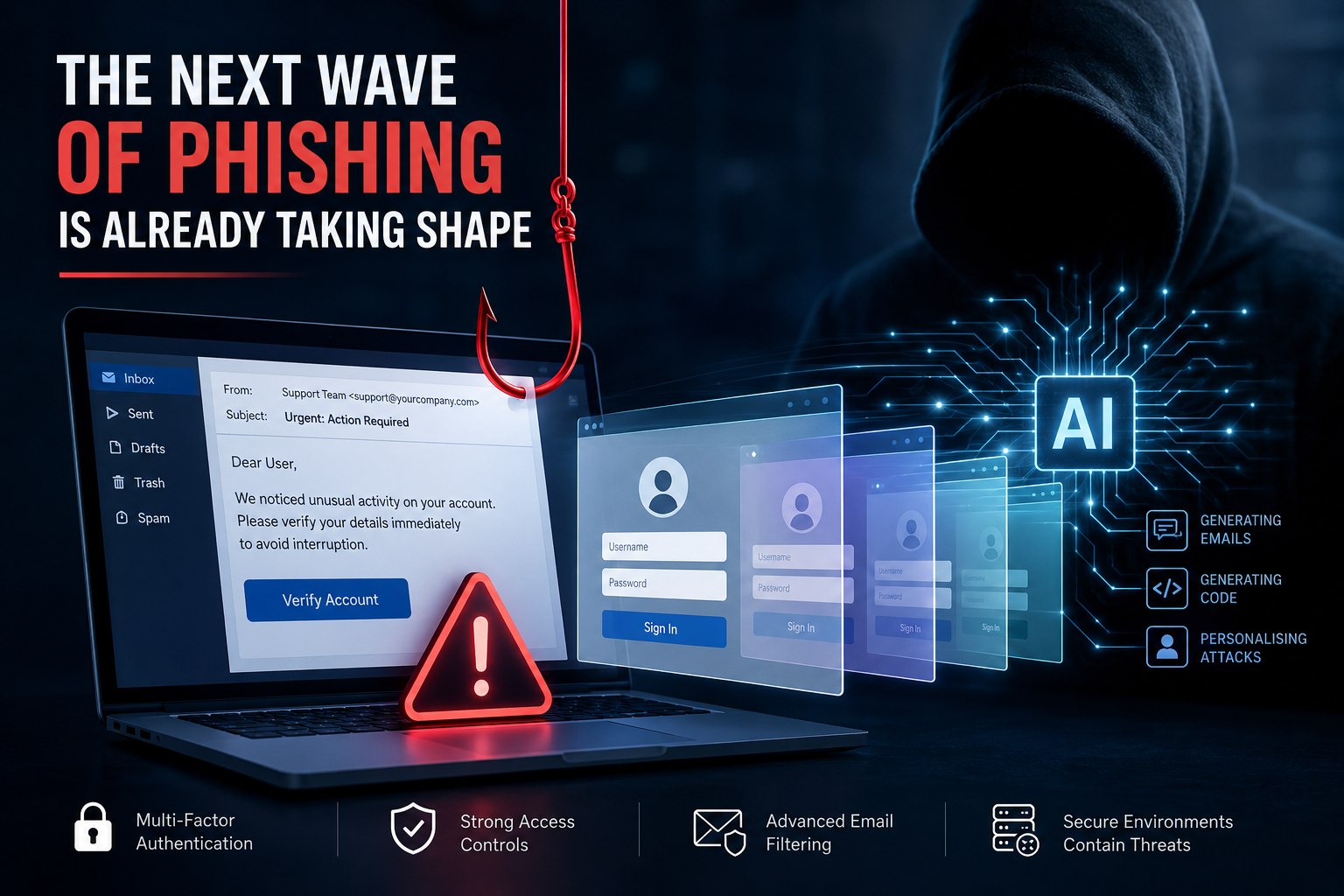
Security researchers are now exploring how AI can be used to generate phishing pages in real time.
Instead of hosting a single fake website, attackers can create content dynamically the moment someone clicks a link. This means the scam can be adapted on the fly.
For example, the page may:
- look slightly different for each person
- use wording that adjusts automatically
- present a layout that feels more natural and familiar
In some cases, there may not even be a fully built phishing page until the exact moment it is opened.
From a security perspective, that makes detection significantly more difficult.
Why this matters now
This approach is not yet widespread, but the building blocks are already in place.
AI is already being used to:
- write more convincing phishing emails
- generate code quickly
- create more personalised attacks
The direction of travel is clear: phishing is becoming more polished and professional.
What this means for your business
Businesses need to rethink how they approach phishing.
It is no longer enough to train people to look for obvious mistakes. Future phishing attacks may:
- be well written
- appear completely legitimate
- reflect genuine business activity
- feel familiar to the person receiving them
In other words, relying on someone to notice that “something looks wrong” is becoming less dependable.
Focus on reducing impact
The most effective defence is not expecting perfect human behaviour. It is reducing the damage if someone does click.
That includes:
- multi-factor authentication to protect accounts
- strong access controls to limit exposure
- email filtering to block known threats
- secure environments that contain potential issues
These measures still matter, even as phishing becomes more convincing.
Stay one step ahead
Phishing is not going away. It is evolving.
The next generation of attacks will be harder to identify, more personalised, and more believable than anything we have seen before.
The businesses that remain protected will not be the ones relying solely on people to catch every threat.
They will be the ones prepared for what happens next.
If you would like to review how well your current setup would cope with this type of threat, please get in touch.